
China’s double kitchen sink industry combines large-scale production with increasingly refined design and quality control. This guide introduces ten notable Chinese manufacturers serving residential, hospitality, and commercial projects. It focuses on practical evidence, not promotional claims. Manufacturing experience, product consistency, export capability, and customer support all matter.
The review considers stainless steel grades, bowl depth, drainage performance, sound insulation, edge finishing, and welding quality. A reliable Kitchen Sink Double should resist daily stains, temperature changes, and repeated cleaning. Details such as a 304 stainless steel body, smooth corners, reinforced undersides, and accurately positioned waste openings can affect installation and long-term use. Factory capacity, inspection procedures, customization options, and certifications also receive attention. Samples and production records often reveal more than attractive catalog images.
No list is flawless. Supplier information can change, and product quality may vary between models or batches. Buyers should request current specifications, material reports, inspection photographs, and shipping references before making a decision. That step is simple. It is also easy to overlook.
The selected manufacturers are presented as a practical starting point for importers, distributors, designers, and homeowners comparing Chinese suppliers. Their strengths may differ: one factory might excel at deep-drawn bowls, while another offers better project customization or faster communication. This introduction does not promise a universal winner. Instead, it encourages careful comparison based on verified performance, transparent pricing, and realistic after-sales support. With those standards, the top ten list becomes more useful, credible, and relevant to actual purchasing decisions.
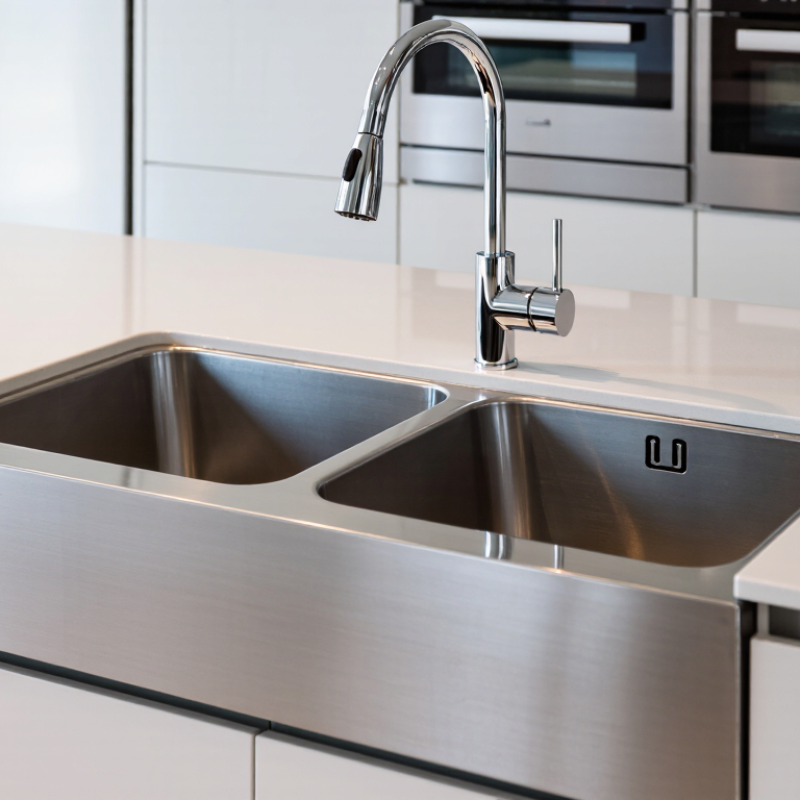
A double kitchen sink is a single sink unit divided into two separate basins. Each basin may have the same depth, or one may be smaller for rinsing and preparation. The central divider supports a simple workflow. Food can be washed on one side while dishes wait on the other. That separation matters. It also helps reduce splashing across clean and dirty areas during busy meal preparation.
In practical kitchen installations, the sink often becomes the main working station. One basin can hold soaking cookware, while the second remains available for rinsing vegetables or filling a pot. This arrangement is useful when a dishwasher is unavailable or used less frequently. Common materials include stainless steel, granite composite, ceramic, and engineered stone. Material choice affects noise, heat resistance, weight, maintenance, and installation requirements. Cabinet support must match the sink’s size and construction.
A double sink is not automatically better for every household. Two narrow basins may limit space for large baking trays. I have also found that a shallow divider can improve handling, but it may allow water and debris to cross over. That detail is easy to overlook. Users should check basin dimensions, drain placement, faucet reach, and counter space before choosing a model. Good design balances hygiene, workflow, durability, and everyday comfort.
Evaluating Chinese double kitchen sink manufacturers requires more than comparing catalog prices. A reliable assessment begins with material evidence. Ask for the stainless steel grade, thickness tolerance, and test records for each model. Samples should show even welds, smooth corners, consistent bowl depth, and clean drainage areas. Run water through both bowls. Watch for slow flow, sharp edges, or pooling near the drain. A factory may describe a sink as handmade, yet production quality can vary between batches. That detail deserves verification.
Visit the facility when possible, or request a live video inspection of the stamping, welding, polishing, and packing lines. Check whether quality staff record inspections rather than relying on verbal promises. Export experience matters too. Review relevant product certifications, packaging tests, container loading photos, and traceable inspection reports. Confirm how the manufacturer handles defective units, replacement parts, and design changes. Clear drawings should define cutout sizes, drain positions, overflows, and surface finish. Lead times need evidence from recent orders, not optimistic estimates. I have found that communication often exposes weaknesses before production begins. Replies may be fast but vague. That is a warning. Cost remains important, but an unusually low quote may reflect thinner steel, weaker packaging, or reduced inspection. Leave room for doubt; even a strong sample does not prove stable long-term output.
A practical comparison framework for assessing double-bowl stainless steel kitchen sink suppliers in China
| No. | Evaluation Criterion | Recommended Benchmark | Documents or Evidence to Request | Why It Matters |
|---|---|---|---|---|
| 1 | Stainless Steel Grade | Food-contact models should normally specify stainless steel such as SUS 304 or an equivalent grade, commonly identified as EN 1.4301. SUS 316 or EN 1.4401/1.4404 may be considered for higher chloride resistance. | Mill test certificate, material grade declaration, and independent alloy verification when required. | The steel grade affects corrosion resistance, durability, hygiene, and long-term appearance. |
| 2 | Material Thickness | Compare the actual measured thickness rather than marketing terminology. Many residential stainless steel sinks are specified around 0.8–1.2 mm, depending on construction, size, and reinforcement. | Technical drawing, incoming-material records, and thickness measurements from multiple points on a production sample. | Adequate thickness helps reduce denting, vibration, distortion, and installation problems. |
| 3 | Manufacturing Process | Evaluate whether the supplier uses controlled deep drawing, welding, grinding, polishing, or precision forming processes appropriate to the selected double-bowl design. | Factory audit, process flow chart, equipment list, quality-control plan, and production photographs or video. | Process control influences bowl geometry, corner consistency, weld quality, and batch-to-batch uniformity. |
| 4 | Dimensional Accuracy | The two bowls, divider, rim, waste openings, clips, and mounting profile should match the approved engineering drawing and installation template. | Approved drawings, dimensional inspection reports, first-article samples, and pre-shipment inspection records. | Accurate dimensions help ensure compatibility with countertops, cabinets, drains, and accessories. |
| 5 | Drainage Design | The base should provide effective water flow toward the waste outlet without persistent standing water under normal installation conditions. Drain size and position must match the target market. | Drainage test results, installation drawings, outlet specifications, and compatibility details for the supplied waste fittings. | Good drainage improves hygiene, usability, and customer satisfaction. |
| 6 | Leak and Structural Testing | Every production batch should be checked for leakage, visible cracks, pinholes, weak welds, deformation, and sharp edges. Critical weld areas require additional inspection. | Quality inspection checklist, leak-test procedure, nonconformity records, and corrective-action reports. | Testing reduces the risk of water damage, installation returns, and hidden manufacturing defects. |
| 7 | Surface Finish and Safety | The finish should be even and free from deep scratches, polishing marks, contamination, burrs, and exposed sharp edges. Brushed, satin, and polished finishes should be defined by approved samples. | Golden sample, surface inspection standard, edge-safety checklist, and pre-shipment photographs. | Consistent finishing affects visual quality, cleanability, handling safety, and perceived product value. |
| 8 | Acoustic and Condensation Control | Where specified, sound-absorbing pads and anti-condensation coating should be applied consistently and securely, without obstructing drainage or installation points. | Material specifications, application photographs, adhesion checks, and sample-based sound or vibration evaluation. | These features can reduce water noise, vibration, and moisture accumulation beneath the sink. |
| 9 | Standards and Quality Management | The supplier should provide applicable product documentation, comply with the buyer’s destination-market requirements, and maintain a documented quality system. EN 13310 may be relevant for kitchen sink performance requirements in applicable markets. | Valid quality-management certificate, certificate scope, product test reports, compliance declaration, and traceability records. | Documented systems make production results more repeatable and simplify regulatory and customer audits. |
| 10 | Packaging, Logistics, and After-Sales Support | Packaging should protect corners, bowls, surfaces, mounting hardware, and drains during export handling. The supplier should also provide clear carton markings, spare-part support, defect procedures, and agreed production lead times. | Packaging test photos, carton specifications, packing list, sample shipping records, service procedure, and written commercial terms. | Effective logistics and after-sales processes reduce transit damage, replacement costs, and project delays. |
China’s top 10 double kitchen sink manufacturers are often evaluated by material quality, production experience, and export reliability. In China, established factories usually offer 304 stainless steel, precise welding, and brushed or satin finishes. These details affect corrosion resistance and daily cleaning. A practical inspection should include sink thickness, bowl depth, corner radius, and drainage design. Thin edges may look acceptable but can vibrate under running water. Small details matter.
The top 10 double kitchen sink manufacturers in China should also provide traceable quality records and stable production capacity. Buyers can request factory audits, product samples, material reports, and packaging tests before placing large orders. Skilled manufacturers commonly support custom dimensions, faucet-hole positions, sound-reduction pads, and protective coatings. Their engineers should explain installation limits clearly. Poor communication remains a real risk. I have found that sample approval alone is not enough; production batches can still vary slightly. This point deserves careful attention. Reliable suppliers usually inspect welding seams, surface consistency, and drainage components before shipment. They should also respond clearly when defects appear, rather than hiding behind standard warranty language. A ranking can guide research, but it cannot replace physical inspection, documented evidence, and direct technical discussion.
China Top 10 Double Kitchen Sink Manufacturers
China’s leading double kitchen sink manufacturers compete through material control, practical design, and consistent production. Many models use SUS304 stainless steel, valued for corrosion resistance and food-contact safety. Some suppliers offer SUS316 for harsher environments, while SUS430 supports more cost-sensitive projects. Thickness commonly ranges from 1.0 to 1.5 millimeters. Thicker steel usually reduces vibration, but it does not guarantee better performance alone.
Useful features include deep bowls, rounded R10 corners, sloped drainage surfaces, and sound-absorbing pads. These details affect cleaning, water flow, and daily noise. Brushed finishes can hide light scratches better than mirror finishes. However, surface appearance may conceal uneven welding or weak edge reinforcement. A careful buyer should inspect both visible and hidden areas.
Reliable manufacturers usually operate under documented quality systems, such as ISO 9001, and follow applicable GB, EN, or ASTM requirements. Production controls may include precise stamping, laser welding, polishing, passivation, and dimensional checks. Quality teams should test leakage, drainage, coating adhesion, and salt-spray resistance. Batch traceability adds useful accountability. Factory audits matter too. Still, paperwork is not proof by itself. I have seen attractive samples fail after rough handling, especially around the drain opening and divider. Independent inspection remains wise before shipment.
The chart compares the minimum chromium and nickel content specified in common stainless steel grades used in kitchen-sink manufacturing. Higher chromium supports corrosion resistance, while nickel generally improves toughness, formability, and resistance to acidic environments. Values are shown as percentage by weight and are based on ASTM A240 composition ranges.
Selecting the right Chinese sink manufacturer requires more than comparing catalog prices. Grand View Research estimates the global kitchen sinks market will grow at about 4.7% annually through 2030. That growth attracts capable factories and inexperienced traders. Verify whether the supplier owns production equipment, or only resells products.
Request a physical sample before signing. Check the 304 stainless steel grade with material documentation, weld consistency, corner radius, soundproof pads, and drainage speed. A thicker sink is not automatically better. Poor forming can still create weak corners. Ask for factory quality records, incoming material checks, dimensional reports, and batch photographs. Independent testing against standards such as ASME A112.19.3 or EN 13310 adds useful evidence.
Production capacity also needs careful testing. Request recent lead-time records, monthly output, carton drop-test results, and a clear replacement policy. The 2024 Houzz Kitchen Trends Study shows that homeowners continue investing in durable kitchen upgrades, but appearance alone does not prove durability.
Visit the factory when possible. Inspect polishing stations, pressing machines, storage conditions, and final inspection areas. I once saw a polished sample hide uneven drainage. Samples can mislead. Confirm the exact model, steel grade, accessories, packaging, and tolerances in the purchase agreement. A reliable manufacturer welcomes measurable checks, not vague promises.