
Finding a dependable Sunnykinte umbrella manufacturer in 2026 requires more than comparing factory prices. It requires evidence. Fortune Business Insights estimates the global umbrella market at approximately USD 7 billion in 2024, with steady growth expected through 2032. Grand View Research also identifies demand for durable, design-focused, and weather-resistant umbrellas. These reports suggest opportunity, but their market boundaries differ. Numbers are not perfectly comparable.
A practical sourcing process should examine production capacity, fabric performance, frame strength, and quality controls. Ask for recent factory photographs, production records, and verifiable certifications. Request samples during heavy opening tests, wind testing, and repeated folding. A reliable supplier should explain canopy fabric composition, rib materials, handle construction, and packaging tolerances. ISO 9001-based procedures can support consistency, although certification alone does not guarantee excellent umbrellas. That assumption needs challenging.
Experience matters at the sampling stage. Check whether the Sunnykinte umbrella manufacturer can reproduce color, logo placement, stitching, and dimensions across multiple batches. Independent inspections from organizations such as SGS, Intertek, or TÜV Rheinland may provide additional confidence before shipment. Review factory communication, corrective-action speed, and defect reporting honestly. A beautiful sample can hide weak mass production. It happens.
This guide will help buyers compare suppliers using measurable criteria, not polished promises. It will connect market evidence with practical factory verification. The goal is a manufacturer relationship that remains dependable after the first order, during seasonal demand, and under real customer use.
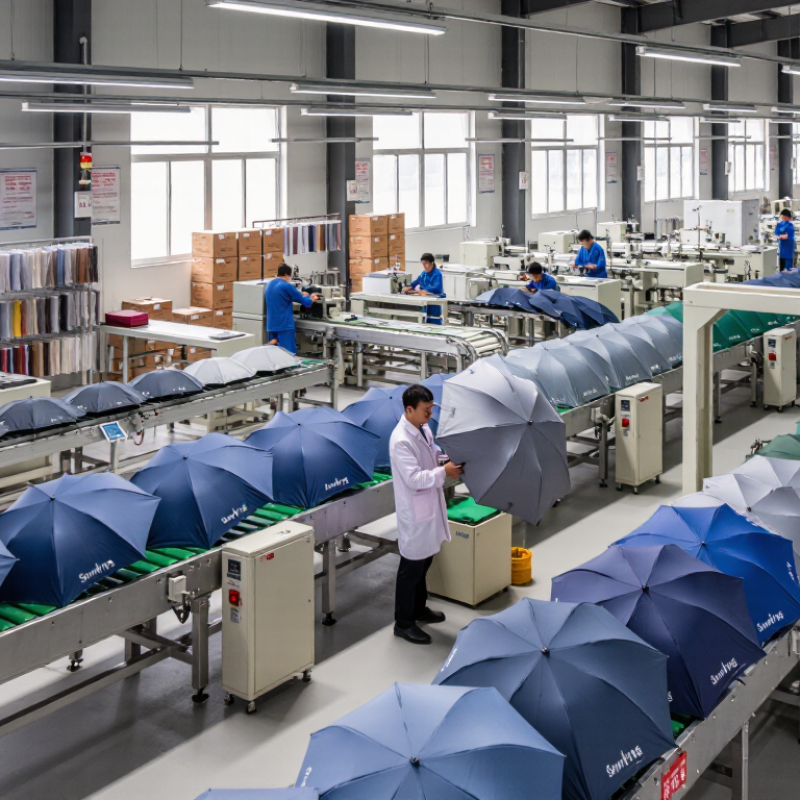
Finding a reliable umbrella manufacturer in 2026 starts with clear manufacturing requirements. Define the umbrella type, canopy size, frame material, handle design, and opening method. Include fabric weight, waterproofing expectations, color references, and packaging details. Details matter. Vague specifications often create expensive corrections later.
I have found that experienced buyers request a physical sample before approving bulk production. The sample should be checked under bright light, in strong wind, and after repeated opening. Inspect stitching, seam sealing, ribs, runner movement, and handle attachment. Ask the factory for material certifications, production photos, and recent quality records. A capable supplier should explain its inspection process without avoiding difficult questions. However, laboratory reports alone cannot guarantee consistent workmanship.
Discuss minimum order quantities, sampling fees, lead times, payment stages, and replacement procedures in writing. Confirm whether the factory controls fabric cutting, printing, assembly, and final inspection internally. This affects traceability and response speed. I would also request a pre-shipment inspection with measurable acceptance standards. Measure twice. A small weakness in a prototype can become a large defect across thousands of units. Communication should be tested, too: send one revised specification and observe how accurately the team updates drawings and samples. Some requirements may need adjustment after testing, especially when appearance, durability, and target cost conflict.
Defining product specifications is the real starting point when choosing an umbrella manufacturer. A clear brief should state the canopy diameter, folded length, opening method, frame material, and target weight. For example, a 110-centimeter canopy needs enough tension to prevent fabric sagging. The handle should feel balanced, not slippery, during wet weather. Small details matter.
QUALITY STANDARDS must be measurable. Request fabric samples with stated polyester density, water-repellent performance, colorfastness, and UV protection. Ask how the factory tests ribs, stretchers, shafts, and automatic mechanisms. A practical evaluation includes repeated opening cycles, controlled wind exposure, water spray, and seam inspection. Check stitching around the canopy tips and runner area. Weak points often hide there. They should not.
A reliable supplier should provide material records, inspection procedures, and sample approval documents. Confirm acceptable tolerances for canopy size, handle color, logo placement, and packed weight. Independent pre-shipment inspections can verify production consistency before payment. My experience is simple: the first sample may still feel wrong, even when measurements pass. I once overlooked a slightly loose rib joint because the umbrella looked attractive. That mistake became expensive during testing. Ask for revised samples, retain a sealed reference sample, and record every change in writing. A good specification protects both performance and communication. Perhaps not perfectly. That is why honest review matters.
Researching potential umbrella manufacturers should begin with evidence, not attractive photographs. I usually build a shortlist of five to eight factories with relevant product experience. Check their website, export history, production range, and stated monthly capacity. Then request business documents and recent product catalogues. A polished website can still mislead. Look for consistent company details across trade platforms, official records, and supplier replies.
Ask each manufacturer for samples using the same specifications. Examine rib alignment, canopy stitching, shaft movement, handle finishing, and opening force. Test the umbrellas under repeated opening cycles and light spray conditions. Record defects with dated photos. Small details matter. A loose rivet may reveal weak process control. Request material information, inspection procedures, packaging options, minimum order quantities, and realistic production schedules. Suppliers who answer precisely are easier to manage.
Shortlist two or three factories after comparing quality, communication, pricing, and delivery risk. Do not choose the lowest quotation automatically. An unusually low price may exclude packaging, inspection, or stable materials. Ask for a sample revision when necessary. This stage can feel inefficient, but rushed approvals create expensive corrections later. I once overlooked unclear carton markings because the sample looked excellent. The shipment planning became unnecessarily difficult. That mistake changed my checklist: every promise now needs written confirmation, an accountable contact, and a measurable requirement.
Evidence-based manufacturer screening matrix for identifying, comparing, and shortlisting qualified umbrella production partners.
| Research Dimension | Measurable Requirement | Recommended Screening Benchmark | Evidence to Request | Priority | Status |
|---|---|---|---|---|---|
| Legal and Export Eligibility | Confirm that the factory is a legally registered manufacturing or export entity. | Registration details, registered address, business scope, and export capability should match the proposed production site. | Current business license, export registration information, factory address, and a video or in-person site verification. | High | Required |
| Quality Management | Assess the consistency of production, inspection, corrective action, and document control. | ISO 9001:2015 certification is a useful screening benchmark, but the certificate should cover the relevant manufacturing activities. | Certificate number, certification scope, issuing body, validity dates, and an independent certificate-verification result. | High | Recommended |
| Umbrella Product Standard | Evaluate opening force, closing function, durability, corrosion resistance, fabric attachment, and general construction. | Ask whether products can be tested against ISO 5912:2021, “Umbrellas — Requirements and test methods,” where applicable. | Recent laboratory report, test sample, test standard version, sample identification, and test date. | High | Required |
| Fabric Water Repellency | Check whether canopy fabric resists wetting after production and after repeated use. | Use a defined spray-rating or equivalent internal requirement; AATCC TM22 is a recognized spray-test method for textile water repellency. | Fabric specification, coating composition, laboratory report, test method, rating, and wash or abrasion conditioning details. | High | Required |
| UV Protection Claims | Substantiate any UPF, UV-blocking, or sun-protection claim made for the canopy fabric. | UPF 50+ should only be used when supported by a suitable laboratory test and an agreed test method, such as AS/NZS 4399 for textile sun-protective evaluation where appropriate. | UV-transmission report, fabric composition, test method, test laboratory, and exact wording permitted on packaging. | High | Required |
| Material Compliance | Control restricted substances in fabric, coatings, plastics, metals, inks, and packaging. | For products placed on the EU market, review obligations under REACH Regulation (EC) No 1907/2006 and obtain material-specific declarations or test reports. | Bill of materials, supplier declarations, chemical test reports, ink and coating information, and documented substance-management procedures. | High | Required |
| Social Compliance | Review labor, health and safety, working-hour, wage, and environmental practices. | A recent independent social-audit report, such as a valid SMETA assessment, is stronger evidence than an unsigned supplier statement. | Audit report, audit date, facility address, scope, finding status, corrective-action plan, and closure evidence. | High | Recommended |
| Production Capacity | Determine whether the factory can support the expected monthly volume without outsourcing critical operations. | Capacity should be supported by machine lists, staffing, production lines, working shifts, and recent order history rather than a single sales estimate. | Monthly capacity by product type, line layout, equipment list, key-process outsourcing disclosure, and capacity-allocation plan. | High | Required |
| Minimum Order Quantity | Compare MOQ by model, color, fabric, logo method, packaging, and custom tooling. | Request separate MOQs for stock components, custom colors, custom printing, private packaging, and new mold development. | Written quotation showing unit price, MOQ, sample fee, mold fee, packaging charge, and conditions for mixed-color orders. | Medium | Required |
| Sampling and Approval | Measure how reliably the supplier converts a brief into an approved production sample. | Use a documented sample process with material approval, dimensional checks, artwork approval, and a signed golden sample. | Sample timeline, revision policy, sample checklist, approved reference sample, and pre-production approval form. | High | Required |
| Quality Inspection Plan | Define incoming, in-process, final, and pre-shipment inspection controls. | AQL 2.5 may be used as a buyer-set starting point for major defects under ANSI/ASQ Z1.4; the buyer must define sample size and defect classification. | Quality-control plan, inspection checklist, defect photos, sampling plan, inspection records, and corrective-action procedure. | High | Required |
| Packaging and Labeling | Check whether packaging protects the umbrella and meets destination-market labeling requirements. | Confirm carton dimensions, packing quantity, barcode placement, care information, country-of-origin marking, and packaging-material requirements. | Packaging specification, carton drop-test evidence where required, artwork proof, barcode test, carton-marking sample, and packing photos. | Medium | Required |
| Cost and Trade Terms | Compare the complete landed-cost structure instead of comparing unit price alone. | Request quotations under clearly stated Incoterms® 2020, currency, shipment port, payment schedule, tooling ownership, and validity period. | Itemized quotation, Incoterms® 2020 rule, freight assumptions, tooling terms, payment terms, and price-adjustment conditions. | High | Required |
| Lead-Time Reliability | Separate sample lead time, production lead time, and shipping time. | Use the supplier’s documented historical on-time-delivery rate and require a milestone schedule for materials, production, inspection, and dispatch. | Recent delivery records, production calendar, agreed order milestones, delay-notification process, and recovery plan. | High | Recommended |
| Communication and After-Sales Support | Evaluate response speed, technical understanding, escalation ability, and complaint handling. | Use a written communication test covering specifications, packaging, defects, delivery changes, and corrective actions. | Named account manager, response-time commitment, escalation chart, warranty policy, complaint log format, and replacement or credit procedure. | Medium | Recommended |
| Shortlist Scoring | Convert collected evidence into a consistent supplier comparison. | Suggested weighting: quality and compliance 30%, product capability 25%, cost 20%, delivery 15%, communication 10%. | Completed scorecard, evidence links, unresolved-risk register, sample evaluation, and final approval decision. | High | Required |
Research note: Standards, regulations, certifications, and audit reports should be checked against the current requirements of the destination market and independently verified before a purchase order is issued.
Finding a suitable umbrella manufacturer in 2026 requires more than comparing online quotations. Factory capability should match your product’s intended use, climate, and expected order volume. Ask for current production photos, sample records, and monthly capacity data. A reliable factory can explain fabric density, frame materials, wind resistance, and printing limits clearly. Visit the cutting, stitching, assembly, and inspection areas when possible. Look for organized storage and traceable batch labels.
Certifications need careful verification. Request copies with issuing-body details, validity dates, and matching factory information. Depending on your market, relevant evidence may include quality-management certification, material testing, colorfastness reports, and restricted-substance compliance. Do not accept a logo on a brochure as proof. I also recommend ordering samples from different production batches. Small differences in canopy tension or handle bonding can reveal weak process control. Testing is not glamorous, but it prevents expensive surprises.
Pricing should be separated into fabric, frame, printing, packaging, tooling, and shipping. Compare complete landed costs, not only the unit price. A very low quotation may hide thinner fabric, weaker ribs, or unclear inspection standards. Ask about payment stages, replacement policies, lead times, and minimum order quantities. Leave room for negotiation, but keep specifications written and measurable. My own evaluations have sometimes trusted polished samples too quickly. That mistake remains useful. Factory claims still need independent checks, especially when a deadline makes caution feel inconvenient.
Evaluating factory capabilities, certifications, and pricing with a practical sourcing scorecard.
The chart shows a suggested 100-point evaluation framework for comparing umbrella factories. Production capability and quality certifications receive the highest weight, while pricing should be assessed together with testing, compliance, capacity, and delivery reliability.
Choosing an umbrella manufacturer in 2026 requires more than comparing quotations. Allied Market Research estimates that the global umbrella market could grow from about US$6.7 billion in 2021 to US$10.3 billion by 2031. That growth increases supplier competition, but it also makes verification more important.
Request a pre-production sample with the exact canopy fabric, rib material, handle, printing, and packaging. Test opening cycles, stitching, colorfastness, water resistance, and wind performance. A sample can still hide weak assembly. Check three units, not one. Record defects with close-up photographs and written measurements. I would also ask for recent factory inspection records and relevant test reports. My checklist would probably miss something.
Production terms should be specific. Confirm the minimum order quantity, approved tolerance, payment stages, lead time, packaging method, and inspection point. Put every approved detail into a signed specification sheet. The supplier should explain how defective units are replaced and who pays related costs. A 2024 supply-chain report from McKinsey highlights the value of resilient, transparent supplier relationships, especially when disruptions affect materials and transport.
Long-term support needs measurable commitments. Ask whether spare parts, replacement samples, artwork files, and reorder records remain available. Set a response target for quality claims, such as two business days. Request quarterly capacity updates before peak seasons. A low price may look attractive today, yet slow communication can quietly damage future orders. The best agreement leaves fewer assumptions.