
A Portable Coffee Grinder For Camping should make good coffee without turning a quiet morning into a gear problem. The right choice depends on your route, brew method, and willingness to hand-grind before breakfast. A small burr grinder can fit beside a mug and stove, yet still produce grounds suited to a pour-over or French press. That matters when coarse, uneven particles leave a cup tasting thin or muddy.
Coffee educator James Hoffmann’s grinder-first approach offers a useful lens for choosing outdoor gear. A camping-focused takeaway is: “Choose consistent grounds in a grinder you’ll actually carry.” Treat that as a practical principle, not a direct quotation. Compare burr design, grind adjustment, capacity, and cleaning. A folding handle may save space, while a sturdy grip can matter more when your fingers are cold. If you camp far from power, a manual model avoids charging worries. Battery-powered options can be convenient at a drive-in campsite, but add weight and another item to maintain.
There is no perfect grinder. A lighter body may feel less stable, and a larger hopper may be unnecessary for one cup. Check whether the burrs can be cleaned without special tools, and consider how easily grounds cling inside. Small details count. A little mess can feel surprisingly irritating on a windy morning. The best choice is the one that matches your coffee routine, packs securely, and still feels reasonable to use when you are tired.
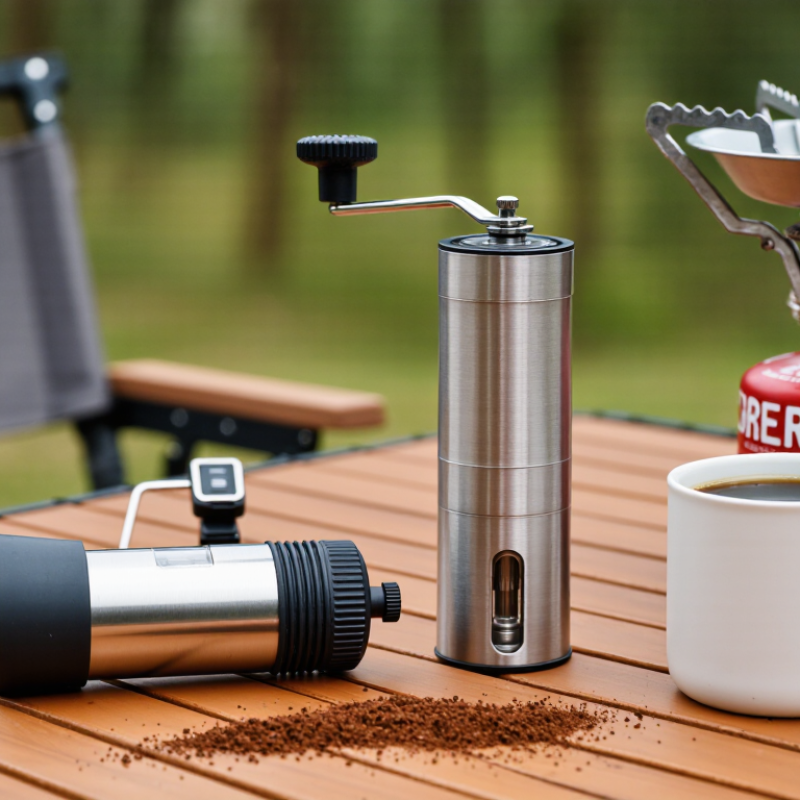
Choose a grinder around the coffee you plan to make, not the coffee you imagine making. For pour-over, look for repeatable, finer settings; for a French press, make sure it can produce a coarse grind without excessive fines. The Specialty Coffee Association’s Golden Cup standard places brewing water at 195–205°F, a useful reminder that grind size is only one part of a good cup. Your brew method and available water both matter.
Camping conditions change the trade-offs. A short walk to a dry campsite may suit a heavier grinder, while a long hike favors a compact model with a secure adjustment dial and few loose parts. If mornings are cold, a small handle can be awkward with stiff fingers. NCA’s 2024 National Coffee Data Trends report found that 67% of U.S. adults drank coffee the previous day, but your own routine matters more than a national average. A few grams saved can help; obsessing over weight can be a mistake.
Tips: Test the grinder at home with your intended beans and brew method. Check whether grounds are easy to empty, and pack it where rain cannot reach it. Manual grinders need no power, but they do take time and effort. If that sounds irritating before breakfast, choose accordingly.
A portable grinder should fit the way you camp, not just your coffee routine at home. Manual models are usually lighter and need no charging. They work well when you have time to turn the handle beside your stove. Their downside is effort: hard beans and fine settings can make a morning grind feel long. Battery-powered grinders are quicker and easier for several cups, but add weight and depend on a charged battery. Cold weather can also reduce battery performance, so check the maker’s operating guidance.
Grind consistency matters with either design. The Specialty Coffee Association’s Golden Cup Standard recommends about 55 grams of coffee per litre of water, with a tolerance of ±10%. That is a brewing guideline, not a grinder test, but repeatable grounds make recipes easier to reproduce. Check adjustment range, burr construction, cleaning access, and capacity before buying. A large hopper may look useful, yet it can waste space on a short trip. I would not choose by speed alone; a noisy motor or awkward handle can matter more at a quiet campsite.
Tips: Weigh your usual dose at home. Test the grinder before packing, including its coarsest setting for a simple pour-over. For battery models, bring a charged backup power source if your trip is long. Manual grinders are not effortless, either.
For camping, choose a grinder by its burrs and adjustment range, not its size alone. Steel burrs are generally durable and quick; ceramic burrs resist corrosion but can chip if dropped on rock. Hand grinders commonly use conical burrs, which fit compact bodies well. Check whether the adjustment clicks are fine enough for your brew method. A coarse press pot and a small pour-over need different particle sizes. A setting number alone can mislead, since adjustment scales vary between grinders.
Consistency matters more than a long list of settings. Uneven grounds can leave a cup both bitter and sour, especially when wind or cold already makes brewing harder. The Specialty Coffee Association’s Brewing Control Chart places its target extraction yield at 18–22% and brewed-coffee strength at 1.15–1.35% total dissolved solids. These ranges are useful reference points, not a promise that every campsite cup will land there. Look for burrs that stay aligned while turning, and test a small dose before packing. Check the grounds on a light-colored surface. Too much powder among the coarse pieces? That grinder may produce less even extraction. A little inconsistency is normal. It is worth noticing.
| Grinder type | Grinding mechanism | Typical adjustment range | Grind consistency | Camping strengths | Trade-offs | Best suited to |
|---|---|---|---|---|---|---|
| Manual conical burr | Two conical burrs crush beans as the handle is turned. | Often adjustable from fine espresso-style settings to coarse immersion brewing; the number of steps varies by design. | Generally even for pour-over and immersion coffee when the burrs are well aligned. | No battery or outlet required; quiet operation; easy to carry and use away from power. | Grinding takes effort and time, especially for multiple servings or very fine settings. | Campers who prioritize portability, quiet use, and reliable everyday brewing. |
| Manual flat burr | Two flat, parallel burrs cut beans into smaller particles. | Usually offers a range of grind sizes; adjustment steps and usable range depend on the model. | Can be very uniform, though alignment and build quality strongly affect results. | Manual operation works without electricity and can deliver controlled grinding. | Often less common in compact hand-grinder designs; may be bulkier or require more careful handling. | Coffee enthusiasts willing to trade simplicity for precise, consistent grinding. |
| Compact electric burr | A motor drives conical or flat burrs; power may come from a rechargeable battery or an outlet. | Typically provides multiple grind settings, but the available range varies; check that it reaches the coarseness needed for your brew method. | Can be consistent when burr alignment and motor speed are well controlled. | Less manual effort and faster preparation; convenient for several cups. | Adds weight and charging needs; battery life, charging access, and cleaning matter on longer trips. | Car campers or travelers with a dependable way to recharge. |
| Blade grinder | A spinning blade chops beans rather than grinding them between burrs. | Usually controlled by grinding time rather than calibrated size settings. | Often produces a wider mix of particle sizes than a burr grinder, which can make extraction less even. | Can be simple and compact; some models are inexpensive and quick to use. | Less control over grind size; many models require electricity or batteries. | Occasional use when compact size or low cost matters more than consistency. |
Values are general characteristics, not specifications for a particular grinder. Before buying, check packed dimensions, weight, adjustment range, cleaning requirements, and power or charging needs against your camping setup.
How to Choose a Portable Coffee Grinder for Camping?
Check Portability, Durability, and Ease of Cleaning
Camping gear earns its place by being useful without becoming a burden. KOA’s 2024 North American Camping Report estimates that about 58 million U.S. households camped at least once in 2023, reflecting the scale of outdoor travel. For a grinder, check its packed size and weight, then see whether the handle or crank fits inside your cook kit. A compact manual model avoids batteries, but tiny parts can be awkward with cold fingers. The lightest option is not always the easiest to use.
Durability matters when equipment rides in a crowded pack. Look for a sturdy body, a secure lid, and burrs that stay aligned; a loose adjustment ring can change grind size during transport. Check whether replacement parts are available, and whether the maker provides clear care instructions. Cleaning should be simple: grounds should brush away without special tools, and the chamber should open without trapping coffee dust in narrow seams. Avoid washing parts with water unless the instructions allow it. Damp grounds can cling and stale quickly.
Tips: Before a trip, grind a small test batch and clean the grinder at home. Pack a soft brush or dry cloth. One easy-to-miss detail: a longer crank can improve leverage, but may snag in a tight bag. Test the packed setup, not just the grinder alone.
A camping grinder should fit your power plan before it fits your shopping budget. The National Coffee Association’s 2024 National Coffee Data Trends report found that 67% of Americans drank coffee the previous day. For a campsite, though, the key figure is on the grinder label: watts. A manual grinder uses no electricity, but takes arm effort. Small trade-off. For a powered model, estimate energy as watts multiplied by operating hours. A 20-watt grinder running for two minutes uses about 0.7 watt-hours. That estimate is imperfect; startup surges and battery conversion losses can raise actual use.
Check twice. Compare the grinder’s input voltage and connector with your battery pack, and leave capacity for a few extra brews. USB-IF’s USB Power Delivery 3.1 specification supports up to 240 watts, but that maximum does not mean every USB outlet can power every grinder. I would not trust a battery’s headline capacity alone; check its usable output and the grinder’s stated requirements. If your budget is tight, a manual model may avoid buying a larger power station just to grind beans. Spend more only when faster grinding or easier adjustment matters to your routine. A cheaper grinder can work, but coarse grounds left in the cup are a frustrating surprise.