
What Is the Best Type of Artificial Marble in China?
Artificial Marble in China spans several different products, not one interchangeable surface. Resin-based cultured marble, quartz-rich engineered slabs, and cement-based terrazzo-style materials can look similar in a showroom. Their performance, maintenance needs, and prices may differ substantially. The best choice depends on where the surface will be installed and how it will be used.
Materials-selection scholar Michael F. Ashby’s approach can be fairly paraphrased this way: “Match the material to the job, not the label.” That principle is useful when comparing Chinese suppliers. A bathroom vanity may benefit from easy cleaning and consistent patterning. A busy kitchen counter needs closer attention to heat, staining, impact, and seam placement. Ask for the product’s composition, care instructions, and test data—not just a polished sample. Check that the sample represents the same color and production batch as the slabs being quoted.
Small details matter. A glossy showroom panel can hide subtle shade shifts, visible joints, or edge weaknesses. Request a larger sample, inspect it under different lighting, and confirm installation requirements in writing. Some buyers focus too heavily on price. I would, too, if the project budget were tight. But a low quote may omit fabrication, transport, or sealing costs. There is no universal winner. The right Artificial Marble balances appearance, durability, maintenance, and verified specifications for the intended space.
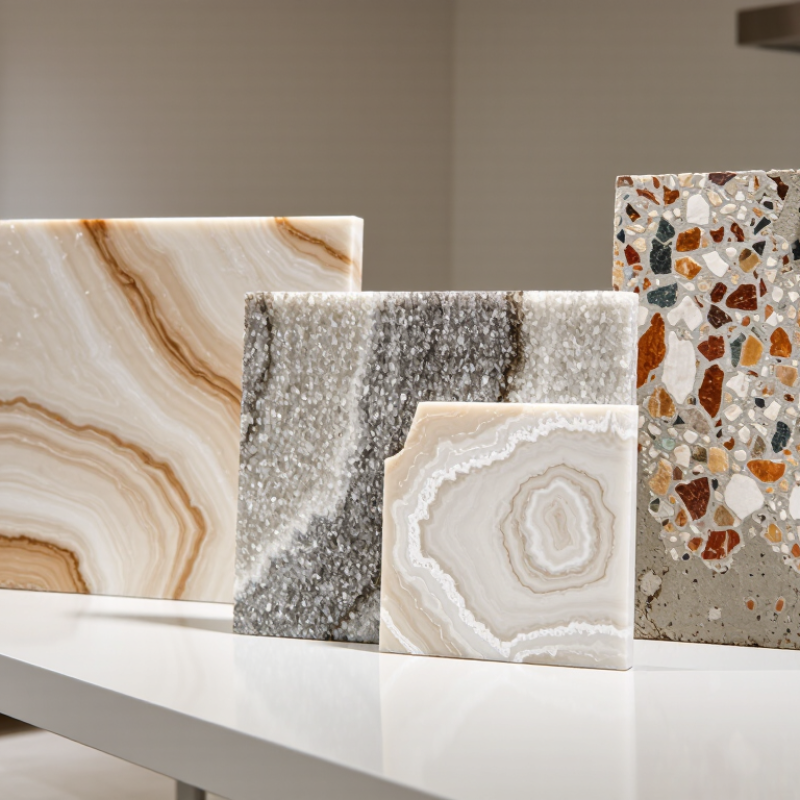
Table of Contents [Hide]
Understanding Artificial Marble and Its Main Types in China
Artificial marble is a broad market term in China, not one single material. It commonly describes engineered quartz, cultured marble, and solid-surface panels. Their appearance may be similar, but their composition and performance differ.
Engineered quartz combines mineral particles with resin, creating a dense surface suited to many kitchen counters. Cultured marble usually blends marble powder and resin; it can form smooth basins and vanity tops, though harsh cleaners may damage its finish. Solid-surface material is often made with acrylic or polyester resin and mineral filler. It can be repaired more easily, but hot cookware may leave marks. Sintered stone is also sold as an engineered surface, though it is not technically artificial marble. Names can vary between suppliers. I would not call one type universally best; usage, fabrication quality, and maintenance matter. A sample may also look different under showroom lights.
Tips: Ask for a cut sample and inspect its edge, pattern, and finish in natural light. Check care instructions and warranty terms. Small details matter. Compare the exact product, not just the category name.
| Material Type | Typical Composition | Main Advantages | Key Limitations | Common Applications | Best Fit |
|---|---|---|---|---|---|
| Resin-based artificial marble | Mineral powders, such as calcium carbonate, combined with polyester resin, pigments, and other additives. | Can reproduce marble-like patterns; available in varied colors and finishes; can be cut and finished for interior applications. | May be scratched or damaged by strong heat; performance depends on the resin, formulation, and manufacturing quality. | Interior wall panels, vanity tops, window sills, and decorative surfaces. | A practical choice when marble-like appearance, design variety, and a moderate budget are priorities. |
| Engineered quartz stone | A high proportion of quartz or other mineral aggregates bonded with resin and pigments. | Generally hard, low-porosity, and easy to clean; offers consistent colors and patterns for countertops and work surfaces. | Resin can be affected by prolonged high heat; seams may be visible; not every product is suitable for outdoor exposure. | Kitchen countertops, bathroom vanity tops, and interior work surfaces. | Often the strongest all-around option for an indoor kitchen when durability and low routine maintenance matter. |
| Acrylic solid-surface material | Acrylic-based resin mixed with mineral filler and pigments; some solid-surface products use other resin systems. | Can be shaped and joined with inconspicuous seams; nonporous surface; scratches can often be repaired by sanding and refinishing. | Usually less resistant to scratches and high heat than engineered quartz; can show wear with heavy use. | Seam-conscious counters, integrated sinks, reception desks, and curved interior designs. | Best when seamless appearance, repairability, or custom shaping is more important than maximum scratch resistance. |
| Cement-based artificial stone | Cement binder combined with aggregates, pigments, and sometimes reinforcing materials. | Can be produced in varied colors and aggregate effects; suitable for architectural and decorative components. | Can be heavier and more porous than resin-based surfaces; may require sealing and careful installation. | Decorative panels, flooring, stair components, and architectural elements. | A suitable option for architectural finishes where a mineral or aggregate appearance is desired. |
| Sintered stone | Mineral materials compacted and fired at high temperature and pressure; it is a manufactured surface, but is not resin-based artificial marble. | Low porosity and strong resistance to heat, stains, and UV exposure when the product is properly specified and installed. | Can be brittle at edges; fabrication and installation require suitable tools and experienced handling. | Countertops, wall cladding, flooring, and some exterior applications. | Worth considering when heat, stain, or outdoor performance is a priority, subject to the product’s technical specifications. |
| Overall guidance: There is no single best type for every project. Engineered quartz is often a strong choice for indoor kitchen worktops, resin-based artificial marble suits decorative interior uses, acrylic solid surface is useful for seamless designs, and sintered stone may be preferable where higher heat or outdoor resistance is required. Compare product test data, intended-use ratings, thickness, finish, fabrication requirements, and installation guidance before purchasing. | |||||